What If the PS1 Never Switched to CDs?
Written by Shimmers
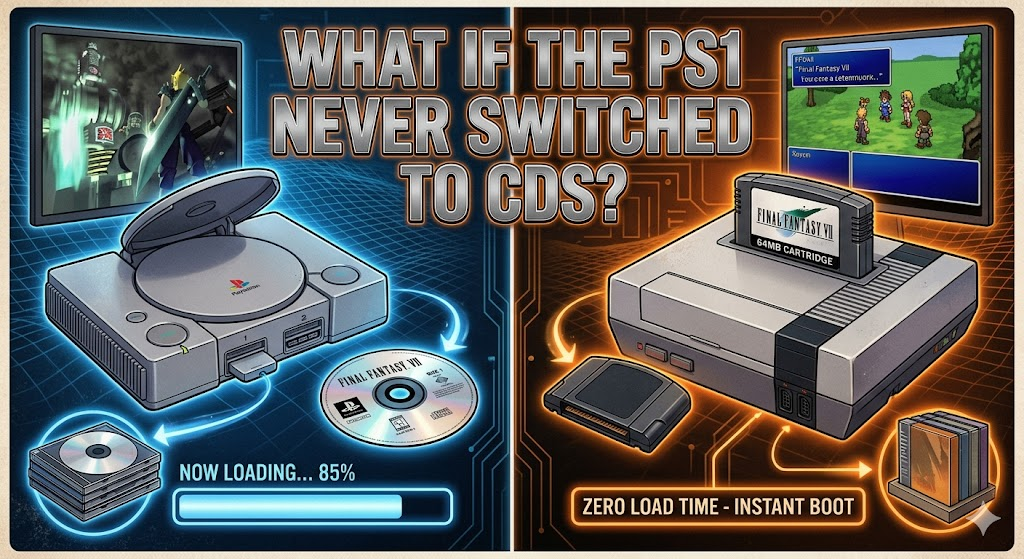
The launch of the PlayStation 1 in the mid-90s was a watershed moment for the gaming industry, primarily due to its move away from cartridges toward CD-ROM technology. This shift allowed for cinematic cutscenes, high-fidelity audio, and massive worlds. But what if Sony had played it safe and stuck with the industry-standard cartridge format used by Nintendo and Sega?
The Technical Trade-off: Speed vs. Space
Switching back to cartridges would have drastically altered how games were developed and played.
- Zero Load Times: The most immediate benefit would be the near-instantaneous loading of games. The “Now Loading” screens that defined the early 3D era would have been virtually non-existent.
- The Storage Wall: While CDs offered roughly 650MB of space, the largest cartridges of the era usually topped out around 64MB. This means expansive RPGs would have been physically impossible or heavily compromised.
- Audio Downgrades: Full Orchestral soundtracks and voice acting would have been replaced by MIDI-based music and text boxes to save precious storage space.
Impact on Iconic Franchises
Many of the games that defined the PS1 era would be unrecognizable in a cartridge-only world.
- Final Fantasy VII: This game famously required three separate CDs. On a cartridge system, the cinematic FMVs (Full Motion Videos) that made it a global phenomenon would have been cut entirely, and the world map would likely have been scaled back to fit the memory constraints.
- Metal Gear Solid: Hideo Kojima’s cinematic masterpiece relied heavily on CD storage for its extensive voice acting and scripted cutscenes. Without it, the “Interactive Movie” feel of the game would have been lost.
- Resident Evil: Pre-rendered backgrounds, which allowed for highly detailed environments, take up significant space. A cartridge version might have been forced to use simpler, real-time 3D environments, losing much of the series’ atmospheric dread.
The Longevity of 2D Art
Because 3D textures and assets are storage-heavy, a cartridge-based PS1 might have inadvertently prolonged the “Golden Age” of 2D gaming.
- Sprite Mastery: Developers would have likely pushed 2D sprite work to its absolute limit, resulting in incredibly fluid animations and vibrant art styles that wouldn’t have been hampered by the “blocky” look of early 3D.
- Genre Shifts: Fighting games and 2D platformers would have remained the dominant genres for much longer, as they were easier to optimize for cartridge memory compared to sprawling 3D adventures.
Comparison: CD vs. Cartridge Reality
| Feature | CD-ROM (Actual) | Cartridge (What If) |
| Storage Capacity | High (~650MB) | Low (~8MB to 64MB) |
| Manufacturing Cost | Very Cheap (Pennies) | Expensive (Hardware inside) |
| Loading Speeds | Slow (Laser seek time) | Instant |
| Cinematics | High-quality FMV | Static images or text |
The Industry Outcome
If Sony hadn’t embraced CDs, the gaming landscape would be vastly different today. The lower cost of CD manufacturing allowed Sony to take risks on niche titles and indie developers, a trend that might have been stifled by the high entry costs of cartridge production. While we would have enjoyed a world without loading screens, we might have missed out on the cinematic evolution that turned video games into a premiere storytelling medium.


Post Comment